The Littlejohns Partnership
Twelve months. One school. Until you don't need us anymore.
The full engagement: everything your school needs to move from AI-overwhelmed to confident, built with your people, measured against your own baseline, and handed over when it's yours.
What is the Littlejohns Partnership?
The Littlejohns Partnership is a twelve-month, educator-led engagement for schools. Vaughn Littlejohns works alongside your school, not above it: a whole-school baseline first, then a governing-body-ready AI policy, whole-school training and internal Champions, finishing with re-measurement and a full handover to your own staff.
Most schools haven't failed at AI. They've been asked to solve it without the time, the team, or the evidence.
By now your school has probably done something: bought training, drafted a policy, blocked some tools and approved others. And still, on a Tuesday morning, every teacher is making their own call and nobody can say with confidence where the school actually stands.
That isn't a competence problem. It's a sequencing and capacity problem, and it's the most normal place in the world to be. You don't have to become the school's AI expert to fix it: part of what a partnership gives you is someone to call when a parent emails or a governor asks.
The partnership exists for exactly this. Not another framework left on a shelf, but a year of working alongside your people, in the right order, until the capability is theirs. By the end, you can answer the parent email and the governor question with evidence rather than a holding line.
The deliverables
What the partnership includes
Everything needed to make it stick. Nothing decorative.
Your baseline, first
An assessment that hears the voice of your whole community: teachers, students, parents and leadership. The output is your baseline, evidence in place of guesswork, and every decision in the partnership is made against it, including the final measurement.
A policy your governors can sign
Governing-body-ready, grounded in safeguarding and your context, built with your people rather than copied from another school.
Whole-school training that lands
Sessions pitched for leadership, senior school and junior school across the year. The test never changes: can your staff use it the next morning?
"That it was very responsive to what I needed, not just being lectured about what exists"
Rachael, Head of Science · AI confidence 2 → 7
Your own internal Champions
A programme that builds a group of your own staff to own the work, so the capability lives in your school and never depends on an outsider being in the building.
Real tools, built alongside your staff
Working AI tools made with your curriculum and subject leads in the room. Your people leave with things they made, understand, and can run.
Evidence it worked
We re-measure against your baseline and hand you the numbers, so you can show your board and community what actually changed.
"What you do have is a pretty special model that is hard to replicate. … We don't have enough models that [look] at a CPD approach over a period of time, building as we go."
Gideon WilliamsFormer Head of Digital Learning · Vibe Coding Collective
Hold us to it
How the partnership is measured
We measure the partnership the way we measure your school.
The baseline taken at the start isn't just for planning. It's the standard we ask you to hold us to. At the end of the year we re-run the measurement, and you see exactly what moved: staff confidence, fluency, and whether the structures we built are carrying themselves.
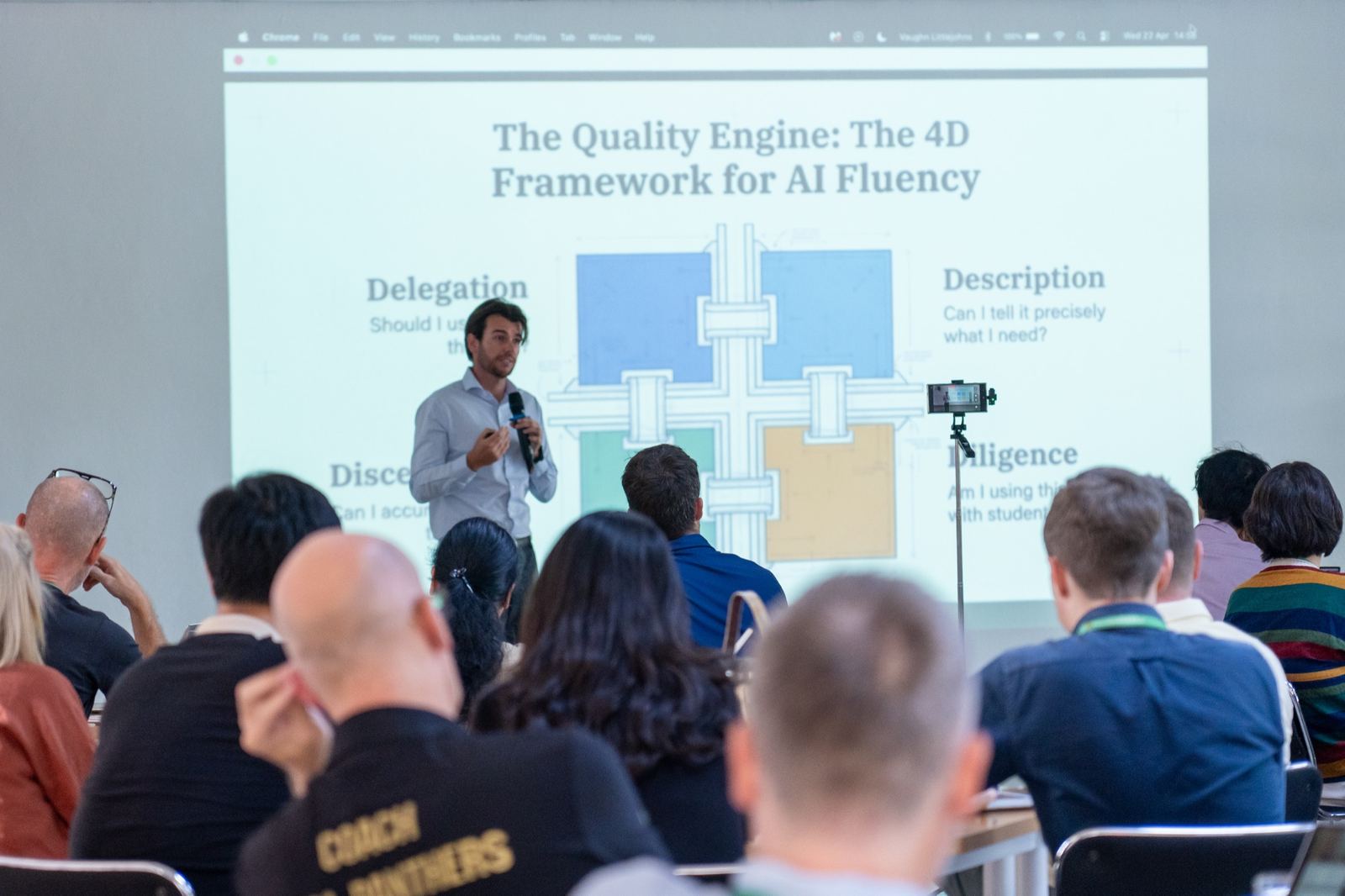
You don't have to take that on trust. At Grey Coat Hospital School in Westminster, teacher confidence managing student AI use moved from 5.5 to 8.1 after a single Traffic Light Framework session, measured before and after on the same scale.
"Putting AI use into context. When, how and why."
Teacher, Grey Coat Hospital School, Westminster · confidence managing student AI use 3 → 8
The guarantee, in plain terms
If your AI policy isn't complete and staff confidence hasn't measurably improved by the second term, we continue working at no extra cost until they are.
We can offer that because everything is measured against your baseline, so neither of us is guessing.
A conversation, not a commitment.
Fit matters more than volume
Who the partnership is for
We take a small number of schools at a time. The work is hands-on, not handed over, and I still lead technology inside my own school every week. That cap is real, which is why fit gets decided honestly on both sides before anything is signed.
The partnership is built for
- Schools with a board or trustee structure
- Heads, deputies and Directors of Technology who feel personally accountable for getting AI right
- Schools where AI has stalled or fragmented: training done, tools bought, and still no shared direction
- Leadership willing to start with evidence rather than assumptions
It's not the right fit for
- Schools wanting a one-off training day with nothing after it
- Schools shopping AI vendors on features and price
- Anyone looking for AI to do the thinking for students, rather than protect it
Not ready for the full year?
Other ways to start
The partnership is the top of the ladder, not the only rung.
The readiness scorecard
Five questions, two minutes. See the step your school is on and the one thing that unlocks the next.
FreeWorkshops and PD
A staff workshop or leadership session: the first taste of the work, built so people use it the next morning.
See the workshopsA talk at your school or event
Keynotes and briefings on AI in schools, from someone still in the job.
Book Vaughn to speakCommon questions
What leaders ask before partnering
How long does a partnership run, and how much of our time does it take?
Twelve months, alongside your school. We shape the rhythm around your calendar: the baseline early, the foundation work across the first terms, training and building through the year, and measurement before handover. Your staff spend their time in sessions that produce things they keep, not in meetings about meetings.
What does it cost?
We don't publish pricing, because the shape of the work depends on your school: size, starting point, and what the baseline finds. The strategy call is where we work out whether this fits, and you'll have a clear picture of the investment before any decision is asked of you.
What if it does not work?
The partnership carries a guarantee: if your AI policy isn't complete and staff confidence hasn't measurably improved by the second term, we continue working at no extra cost until they are. We can offer that because we measure everything against your baseline, so neither of us is guessing.
We have a governors' meeting coming up and need an AI position. Can this help in time?
Often, yes. The baseline is the fastest honest way to walk into that meeting with evidence rather than opinion: where your staff, students and parents actually are, in numbers. A full policy takes longer than one meeting cycle, and we'll be straight about the timeline on the call rather than promise a date we can't keep.
We have an accreditation visit on the horizon. Where does this fit?
Closely. Visiting teams increasingly ask how a school is governing AI, and a policy your governing body has signed plus an evidence trail from baseline to re-measurement is exactly what they ask to see. The partnership produces both as a matter of course, not as extra paperwork before the visit.
What about student data and safeguarding?
It runs through everything. The baseline surfaces the real risk picture in your school rather than the imagined one, the policy is written to be governing-body-ready with safeguarding at its centre, and the training covers in plain terms what school data must never go into public AI tools.
When in the year should a partnership start?
Any time. The baseline doesn't need a budget cycle or a September start, and the rest of the year is shaped around your school's own calendar: terms, training days, inspection windows. Starting from where you are beats waiting for a tidy date.
Will we be locked into one AI tool?
No. The partnership is built on method, not tools. ChatGPT, Claude and Gemini will all change during the year we work together, and again the year after. What your staff keep is the judgement to evaluate whatever arrives next, and a policy written to outlive any single product.
Who actually does the work?
You work with me directly: Vaughn Littlejohns, a practising Director of Technology and former deputy principal, doing this inside my own school every week. As Littlejohns grows, practising educators we train come alongside more schools, but a partnership is never handed to a junior consultant, because there aren't any.
We are not ready for a full partnership. Where do we start?
Start smaller. The readiness scorecard takes two minutes and shows you the step your school is on. A workshop or a talk gives your staff a first taste of the work. And the AI readiness assessment gives you a full evidence baseline. Each one stands on its own, and each one is how partnerships tend to begin.
How it starts
- 1Book the call. Thirty minutes.
- 2We map where your school is and whether this fits.
- 3You get a written next step either way.
The next step
One strategy call. You'll leave with a clearer picture of where your school stands.
Bring your scorecard result if you have one. We'll talk about where your school is, what the right next step looks like, and whether the partnership fits.